
Case Facility Renovation Work
- TOP
- Case Studies
- Removing an Aging Water Storage Tank and Converting to a Direct Booster Water Supply System - Achieving a Comfortable and Reliable Water Supply Environment
Removing an Aging Water Storage Tank and Converting to a Direct Booster Water Supply System - Achieving a Comfortable and Reliable Water Supply Environment
Apartment Building, Tokyo
- #Buildings
- #Apartments
- #Water Supply System Conversion Work
- #Facility Renovation Work
Contents
Background of the Request
We received an inquiry from an apartment management association for which we regularly perform water storage tank cleaning and graywater drainage pipe cleaning about switching to a direct booster water supply system. The inquiry was prompted by a recommendation from the building manager, who had watched over the apartment building for many years. The building manager highly valued our cleaning service response and track record, and the recommendation that “for the plumbing around this important apartment building, AMCON is a company we can trust” led to this opportunity.
Issues Faced by the Management Association
As the building aged, the receiving water tank and water supply pump had deteriorated, raising concerns about maintenance and management costs as well as hygiene, including the piping. Looking ahead to future increases in renovation costs, the association was considering a more efficient and reliable water supply method.
What Is Direct Booster Water Supply System Conversion Work?
A direct booster water supply system supplies water from the water mains directly to each unit while using a booster pump to secure the required water pressure. Compared with a direct pressure water supply system, it can be used in areas where water main pressure is insufficient and in buildings with upper floors, making it a system adopted in many apartment buildings and commercial buildings.
With a conventional receiving water tank system, equipment renewal and maintenance involve significant costs, such as replacing the water supply pump unit (approximately JPY 1.5-2.0 million every 10-15 years) and replacing the receiving water tank (approximately JPY 3.0-4.0 million). With a direct booster water supply system, however, the receiving water tank is no longer necessary, and water can be supplied with only booster pump inspection and replacement.
Advantages
- Major cost reductions because receiving water tank renewal, cleaning, painting, and similar work are no longer required
- Fresh, safe water can always be supplied directly from the water mains to each unit
- Stable water pressure can be secured even on upper floors, improving the living environment
- The space previously occupied by the receiving water tank is no longer needed, allowing the site to be used more effectively
- Many booster pumps are designed for energy efficiency, helping reduce electricity costs
Note: Regular inspection and maintenance of the booster pump are required.
Note: Because there is no storage function during disasters or water outages, temporary water service interruptions may occur.
From Proposal to Contract
We submitted an estimate for conversion work to a direct booster water supply system and held multiple meetings and on-site visits with the board members. We also had opportunities to explain the proposal directly at board meetings and provided careful explanations over approximately one year. As a result, our cost advantages compared with other companies, together with our track record and flexible response, were recognized, and we received the formal order.
Work Details and Duration
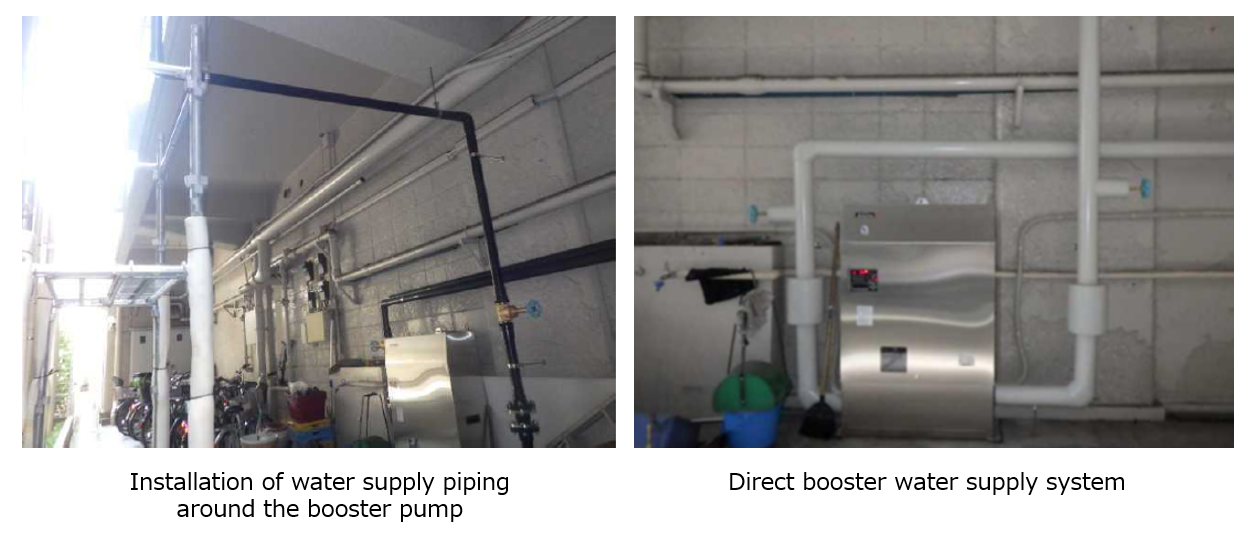
The work was carried out over approximately three weeks. The existing elevated water tank was removed, and a booster pump was installed, completely renewing the building’s water supply system.
Results After Completion
- We received feedback that water pressure on the upper floors had improved.
- In terms of maintenance and management, only one annual booster pump inspection is now required, resulting in cost reductions and reduced labor.
- Eliminating the water storage tank resolved hygiene concerns and created a safe and reliable water supply environment.
By switching to a direct booster water supply system, the property achieved many benefits, including stabilized water pressure, reduced maintenance and management costs, improved hygiene, reduced management workload, and more effective use of space. If you are considering a change in water supply system, including concerns about aging water supply equipment, water pressure, or hygiene, please feel free to contact us. We will propose the most suitable improvement method for your building.
