
Case Cleaning Service of Plumbing Systems
- TOP
- Case Studies
- Discovered During Periodic Water Storage Tank Cleaning! Early Response to a Pressure Tank Failure in a Water Supply Pump Unit Prevents Water Supply Trouble
Discovered During Periodic Water Storage Tank Cleaning! Early Response to a Pressure Tank Failure in a Water Supply Pump Unit Prevents Water Supply Trouble
Apartment Building, Tokyo
- #Cleaning Service of Plumbing Systems
- #Drinking Water Storage Tank Cleaning
- #Apartment Building
Contents
Equipment Status and Background to Periodic Cleaning
The receiving water tank at this apartment building has an effective capacity of 3.75 m³, so it does not fall under the Building Water Tank System category that applies when the effective capacity of a receiving water tank exceeds 10 m³ under Japan’s Waterworks Law.
However, regardless of the size of a water storage tank, stagnant water can easily accumulate scale, sediment, rust, and other deposits. Without proper management, the risk of water quality deterioration and hygiene-related problems may increase.
To maintain a hygienic and safe water supply environment, this apartment building regularly requests receiving water tank cleaning.
Details of Periodic Cleaning
For this work, we carried out the following series of processes.
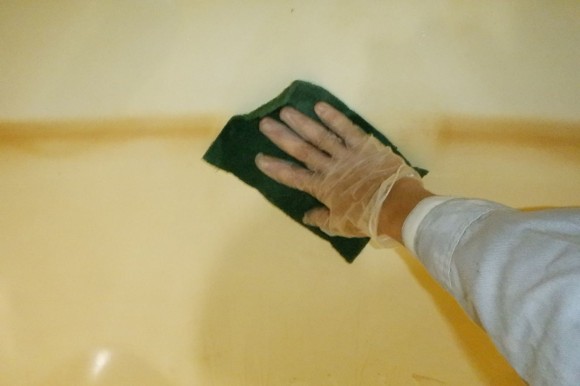
- Cleaning the inside of the receiving water tank
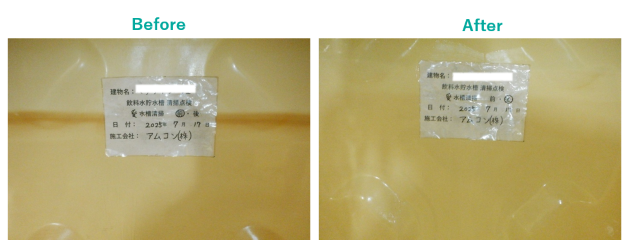
- Disinfection work
- Cleaning the exterior wall of the receiving water tank
- Equipment inspection
- Simple water quality testing (on-site checks such as residual chlorine measurement)
Water storage tank cleaning is not only a hygiene management task; it is also an important opportunity to check the condition of the entire water supply system. In addition to cleaning, we also inspect related equipment.
Water Supply Equipment Failure Found During Inspection
During the water supply equipment inspection carried out together with the cleaning work, we found an abnormality in the water supply pump unit.
Inside the pressure tank, water had entered the air chamber where air should normally be retained. The diaphragm—the rubber membrane that separates air from water—had been damaged due to age-related deterioration.
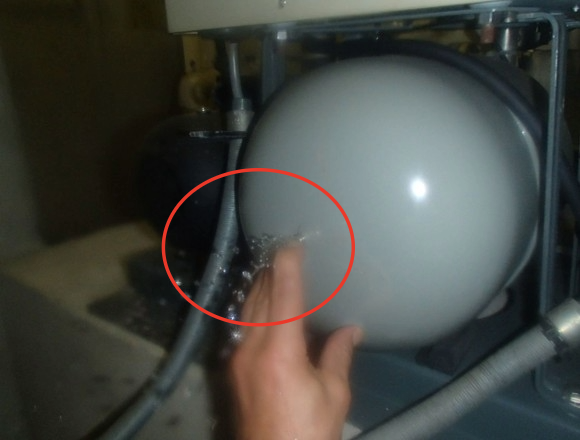
If the equipment continued to be used in this condition, it could lead to problems such as:
- Unstable water pressure inside the water supply pipes, resulting in poor water flow
- Frequent short-cycle starting and stopping of the pump (chattering), placing excessive load on the motor and control board
- A shortened service life of the pump itself and an increased risk of future failure or water outage
These issues could develop into equipment trouble.
AMCON’s Solution
We reported the failure to the property management company and proposed early parts replacement.
We then carried out pressure tank replacement work. Before the work, we notified residents of the planned water outage through the property management company. We then removed the existing pressure tank, replaced it with a new part, adjusted the internal pressure, and performed operation checks. Through advance coordination, we completed the work while minimizing the water outage time.
During the work, we also newly identified an abnormal noise (metallic sound) during operation of another water supply pump. We reported this to the property management company as well and proposed that they consider a renewal plan based on future deterioration conditions.
Water storage tank cleaning is work performed to supply clean water, and at the same time it is a valuable opportunity to check the condition of water supply equipment that is usually out of sight.
At AMCON, we carefully inspect the condition of the entire water supply system together with cleaning work. For any failures found, we provide renovation proposals and, when necessary, offer one-stop support through to renovation work.
To maintain a safe and comfortable water supply environment for residents, we recommend periodic cleaning about once a year from the standpoint of hygiene management.
