
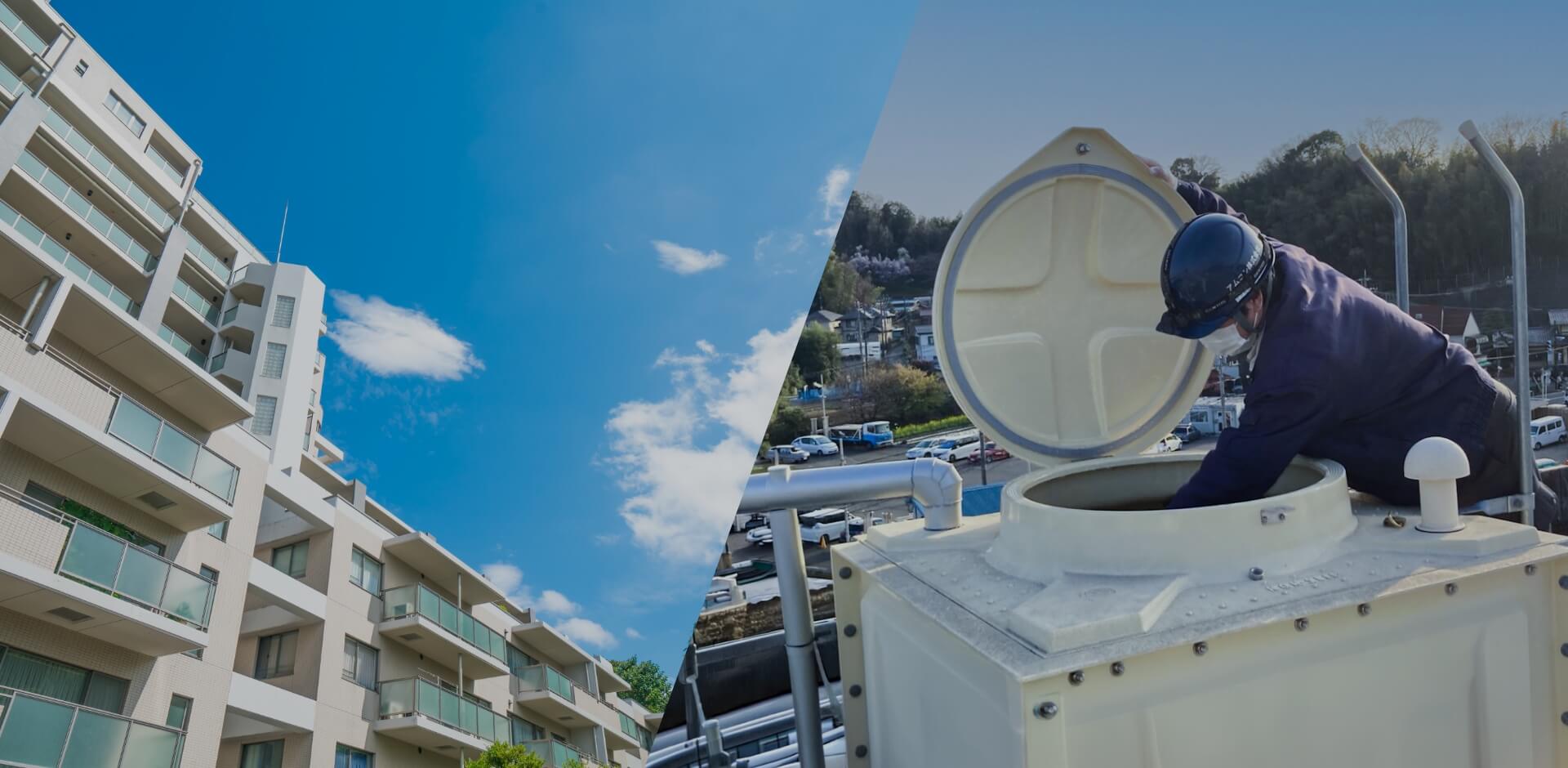
Column Facility Renovation Work
- TOP
- Useful Information
- Facility Renovation Work
- Water Supply Method Conversion Work | Differences Between the Direct Booster Water Supply System and the Direct Pressure Water Supply System
2025.03.03
Water Supply Method Conversion Work | Differences Between the Direct Booster Water Supply System and the Direct Pressure Water Supply System
Contents

For those considering water supply method conversion work, this article explains in detail the differences between the direct booster water supply system and the direct pressure water supply system, as well as the characteristics of each. It also introduces the advantages and disadvantages of each system.
What Is Water Supply Method Conversion Work?
Water supply method conversion work reviews the method used to supply water to buildings and residences in order to achieve a more efficient and stable water supply.
When an existing water supply system has deteriorated due to aging or has issues with water pressure, conversion to a new system may be considered.
Types of Water Supply Systems
There are mainly three types of water supply systems: the direct booster water supply system, the direct pressure water supply system, and the water storage tank water supply system. Each system has its own characteristics, and the optimal system is selected according to the scale and intended use of the building.
Need for Water Supply Method Conversion
With growing emphasis on energy savings and environmental considerations, more cases involve converting to a more efficient water supply system. In addition, when introducing the latest water supply technologies in connection with new construction or renovation work, it is possible to create a comfortable living environment.
How Does Water Come Out of the Faucet?
The mechanism by which water comes out of a faucet involves the coordinated operation of many elements within a complex water supply system. Let us take a closer look at how water supplied from a water source reaches us through the piping networks in homes and buildings.
Supply from Water Sources
Broadly speaking, water is first supplied from sources such as river water and groundwater. Water is pumped from these sources managed by the waterworks bureau and then purified at a water purification plant.
At the water purification plant, filtration and disinfection processes are performed, preparing safe and clean water for supply to each household.
Water Purification Treatment and Distribution System
Purified water is sent to households and facilities through distribution pipes. In urban areas, extensive distribution networks are built and designed to supply water efficiently.
Distribution pipes are installed underground, and the optimal routes are selected according to environmental conditions and urban planning.
Role of Water Supply Pumps
In urban areas and high-rise buildings, water supply pumps play an important role in maintaining water pressure.
Water supply pumps provide the pressure needed to send water to higher locations and secure stable water pressure. As a result, sufficient water volume can be supplied even to distant areas and upper floors.
Indoor Piping System
Inside a home, branch pipes extend from the main pipe to each room and facility. Common piping materials include PVC pipes and PEX pipes, ensuring durability and safety.
The piping system is carefully designed to deliver the appropriate amount of water to the necessary locations.
Characteristics of the Water Storage Tank Water Supply System
The water storage tank water supply system stores water in a water storage tank and distributes it as needed.
This system is particularly suitable for areas where insufficient water pressure is a concern, or for buildings that require a stable water supply. Another advantage is that the water remaining in the water storage tank can be used during disasters and other emergencies.
What, then, are the advantages of switching from a water storage tank water supply system to a direct water supply system?
- Because a water storage tank is not used, cleaning and inspection of the water storage tank are no longer necessary, simplifying maintenance and reducing costs.
- Because water is supplied directly from the water main, more hygienic water can be supplied stably.
- Because a water storage tank is no longer required, the space can be used for other purposes.
- Because the pressure in the distribution pipes is used directly, energy efficiency improves.
Let us now look at the characteristics of direct water supply systems.
Characteristics of the Direct Booster Water Supply System
Installation of a Booster Pump
A key characteristic of the direct booster water supply system is the installation of a booster pump. It is suitable for small to medium-sized buildings, up to approximately 15 stories. This pump draws water directly from the water main, boosts it to the required pressure, and supplies it to each household or building. Booster pumps are usually installed in the basement or mechanical room of a building, with noise-control and vibration-suppression measures in place. Rooftop installation is also becoming more common. When selecting a booster pump, an appropriate capacity is required according to the scale of the building and the volume of water used.
Stable Supply of Water Pressure
The introduction of a booster pump makes it possible to supply stable water pressure. In high-rise buildings and areas where water pressure tends to be insufficient, maintaining stable water pressure is important.
The direct booster water supply system automatically activates the pump according to demand and constantly secures a consistent level of water pressure.
Characteristics of the Direct Pressure Water Supply System
A Pump-Free System
The greatest characteristic of the direct pressure water supply system is that it does not require a pump. This system supplies water directly from the water main to the building and uses the existing pressure of the municipal water supply, eliminating the need for additional pump equipment or power supply. It is mainly suitable for small-scale buildings up to three stories.
Differences Between the Direct Booster Water Supply System and the Direct Pressure Water Supply System
The selection of a water supply system is greatly affected by the scale and use of the building, water pressure requirements, and other factors.
Here, we explain in detail the main differences between the direct booster water supply system and the direct pressure water supply system.
Comparison of Water Pressure Performance
Water pressure performance is one of the most important factors in selecting a water supply system.
| Water Supply System | Stability of Water Pressure | Maximum Water Pressure |
| Direct Booster Water Supply System | Very stable | Higher |
| Direct Pressure Water Supply System | Natural water pressure | Depends on the location |
With the direct booster water supply system, the use of a booster pump makes it possible to maintain constant water pressure at all times.
On the other hand, with the direct pressure water supply system, water pressure depends on the pressure in the local area, so fluctuations in water pressure may occur.
Initial Investment and Operating Costs
Initial investment and operating costs are also important points when choosing a water supply system.
| Water Supply System | Initial Investment | Operating Costs |
| Direct Booster Water Supply System | High | Slightly higher (pump electricity costs, etc.) |
| Direct Pressure Water Supply System | Low | Lower (because there are fewer mechanical components) |
With the direct booster system, the pumps and piping system have high durability and can be used for a long period if properly maintained. However, these mechanical components require periodic inspections and replacement.
On the other hand, the direct pressure system has fewer mechanical components, so the risk of failure is low and less maintenance is required. However, its service life may be affected by the structure of the building and fluctuations in water pressure.
Advantages and Disadvantages of Water Supply Method Conversion Work
Advantages and Disadvantages of the Booster System
The booster system is a method of installing a booster pump to strengthen water pressure and water volume.
Advantages
- Stable supply of water pressure is possible, and the system is particularly effective for high-rise residences and large buildings.
- Because water pressure can be improved immediately, there is no need to make major changes to the existing piping system.
- Flexible installation locations are possible, and booster pumps can be added or adjusted within certain conditions as needed.
Disadvantages
- Initial investment may be high because installation costs for the pump and related equipment are required.
- Periodic maintenance is necessary, and operating costs may increase due to pump failure or wear.
- Space must be secured because a location is needed to install the booster pump.
Advantages and Disadvantages of the Direct Pressure System
The direct pressure system is a method of supplying water directly from the water main without using a pump.
Advantages
- Initial costs are reduced because the cost of installing a pump is not required.
- There is no risk of pump failure, and maintenance is not required.
- Installation space can be saved, making the system easy to introduce even in limited spaces.
Disadvantages
- It is difficult to apply to high-rise buildings or areas with low water pressure, and it is limited to small-scale buildings up to three stories.
- Large-scale piping work may be required, and introduction may be difficult in existing buildings.
- Delays in water supply may occur, and the system may have difficulty responding to instantaneous water demand.
Costs Required for Water Supply Method Conversion Work
Material costs for water supply method conversion work are related to equipment such as piping materials, pumps, and water storage tanks used for the work. Construction costs are determined based on the labor costs of the contractor actually performing the work and the construction period.
Summary
In this article, we introduced water supply method conversion work.。
When considering water supply method conversion work, it is important to fully understand the characteristics and differences of the direct booster water supply system and the direct pressure water supply system.
The booster system can provide a stable supply of water pressure and is suitable for high-rise buildings or cases where insufficient water pressure is an issue. On the other hand, the direct pressure system can reduce initial investment and maintenance costs, making it suitable for cost-conscious residences.
