
Business Laws, Inspections, and Cleaning Obligations for Plumbing Systems
- TOP
- Laws, Inspections, and Cleaning Obligations for Plumbing Systems
- Legal Basis and Assignment of Responsibilities in Plumbing System Management
- Inspection and Cleaning Obligations for Water Supply Systems: Focusing on Water Storage Tanks
- Cleaning Standards for Drainage Systems: Bridging the Gap Between Law and Practice
- Responding to Equipment Aging: Managerial Responsibility and Long-Term Repair Plans
- Legal Compliance as the Starting Point for Trusted Building Management
- Service List
Laws, Inspections, and Cleaning Obligations for Plumbing Systems |
Legal Obligations and Practical Management Standards
Managing plumbing systems involves not only practical recommendations about what should be done, but also legal obligations about what must be done. After understanding the types of equipment and the key points for maintenance, the next area to confirm is laws, inspections, and cleaning obligations.
“Which laws apply to our building?” “Are the inspection and cleaning frequencies stipulated by law?” Many people may find it difficult to grasp the overall picture because multiple laws and regulations are involved. This article organizes and explains the legal basis and practical inspection and cleaning standards related to plumbing system management.
Index
- Legal Basis and Assignment of Responsibilities in Plumbing System Management
- Inspection and Cleaning Obligations for Water Supply Systems: Focusing on Water Storage Tanks
- Cleaning Standards for Drainage Systems: Bridging the Gap Between Law and Practice
- Responding to Equipment Aging: Managerial Responsibility and Long-Term Repair Plans
- Legal Compliance as the Starting Point for Trusted Building Management
- Service List
Legal Basis and Assignment of Responsibilities in Plumbing System Management
Building owners, managers, installers, and other responsible parties may have management responsibilities under multiple Japanese laws and regulations, depending on the equipment and the building’s use. Even when the work is outsourced to a contractor, legal responsibility remains with the building owner or manager. It is therefore essential to understand, at minimum, which laws apply to your building.
Main Related Laws and How They Apply
※You can scroll horizontally to view the table.
| Law / Regulation | Main scope of application | Overview of management obligations |
|---|---|---|
| Japan’s Building Sanitation Law (Building Management Law) |
Specified buildings (in principle, buildings with a total floor area of 3,000 m² or more. However, schools prescribed in Article 1 of Japan’s School Education Act are subject to the threshold of 8,000 m² or more.) | Compliance with maintenance and management standards for plumbing systems; appointment of a Building Environmental Sanitation Management Engineer |
| Japan’s Waterworks Law | Building Water Tank System (a system that uses only water supplied by a waterworks utility as its water source and has receiving water tanks, etc. with an effective capacity exceeding 10 m³), etc. | Implementation of periodic inspections at least once a year and appropriate cleaning |
| Japan’s Fire Service Act | Buildings with fire extinguishing equipment such as sprinklers | Periodic inspections and reporting to the fire department |
| Local government ordinances and guidelines in Japan | Small-scale water storage tanks (10 m³ or less), etc. | Cleaning, inspection, water quality checks, and similar actions may be required (requirements differ by local government). |
These laws and regulations represent only the minimum requirements. While fulfilling these obligations, adopting a preventive maintenance perspective beyond simple compliance helps extend the service life of the building and gives residents peace of mind.
Inspection and Cleaning Obligations for Water Supply Systems: Focusing on Water Storage Tanks
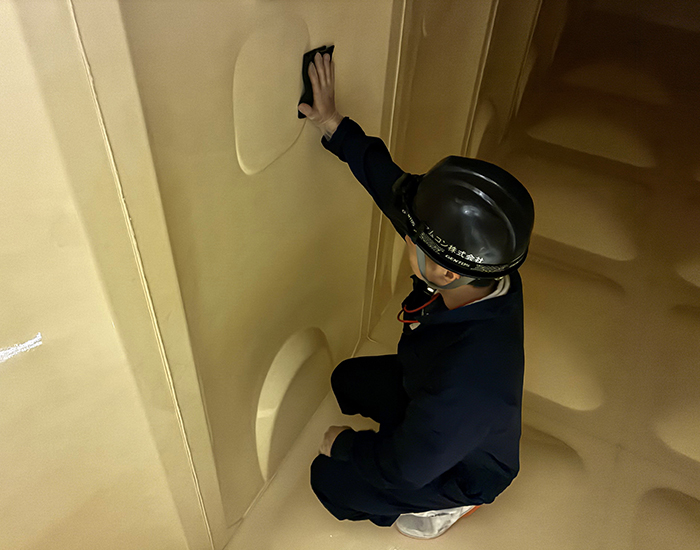
Periodic cleaning and inspection of water storage tanks (receiving water tanks and elevated water tanks) are required under Japan’s Waterworks Law and local government ordinances in Japan.
Rust, sediment, and algae can easily develop inside tanks. If left unattended, they can directly contaminate drinking water. Because water quality problems can develop into health risks, regular action is required of managers regardless of whether a specific legal obligation applies.
Management Categories Based on Water Storage Tank Size
The applicable laws and required actions differ depending on the effective capacity of the water storage tank.
Building Water Tank System (effective capacity exceeding 10 m³)
This system is subject to Japan’s Waterworks Law, and a periodic Building Water Tank System Inspection at least once a year by a registered Building Water Tank System inspection institution is required. Cleaning must also be performed at least once a year, and it is important to keep records so that the inspection and management status can be verified.
Small-Scale Water Storage Tank (effective capacity of 10 m³ or less)
Although these tanks are not directly subject to Japan’s Waterworks Law, the required response differs by local government ordinance or guideline in Japan. Some local governments require cleaning and inspection approximately once a year, while others treat it as a recommendation. It is therefore necessary to check with the local government where the building is located. In any case, the fact that Japan’s Waterworks Law does not apply does not mean that no management is needed.
Cleaning Standards for Drainage Systems: Bridging the Gap Between Law and Practice
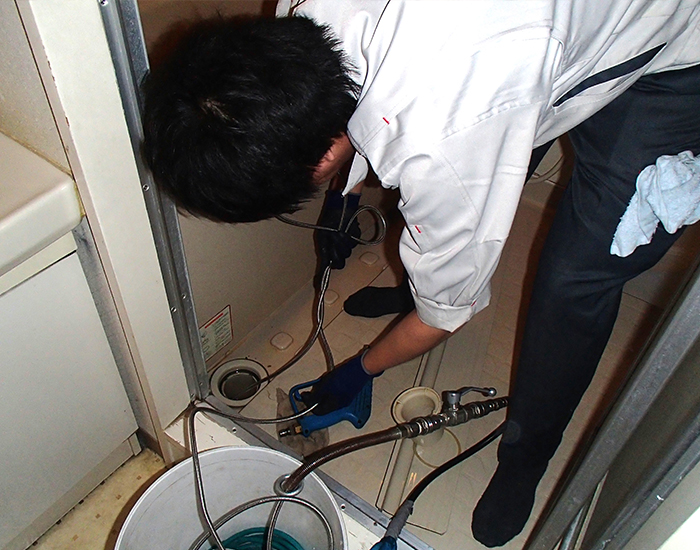
For general buildings other than specified buildings, Japan’s Building Sanitation Law does not set a uniform statutory frequency for drainpipe cleaning. In practice, however, periodic cleaning according to building conditions is essential.
A clogged drainpipe can lead directly to serious harm for residents, such as backflow into private units, leakage to lower floors, and unpleasant odors. Regardless of whether a legal obligation applies, this is an area that building managers must address.
Cleaning Obligations Established by Law (Specified Buildings)
For specified buildings subject to Japan’s Building Sanitation Law (the Building Management Law)—in principle, buildings in which the total floor area used for specified purposes is 3,000 m² or more; however, schools exclusively prescribed in Article 1 of Japan’s School Education Act are subject to the threshold of 8,000 m² or more—drainage system cleaning must be performed once every six months or less.
Practical Cleaning Guidelines for Buildings Outside the Statutory Scope
For general apartment buildings and small- to medium-sized commercial buildings that do not qualify as specified buildings, there is no statutory obligation for drainpipe cleaning. Even so, there are clear reasons why periodic cleaning is regarded as a practical standard.
- Grease, soap residue, hair, and similar substances gradually accumulate, and if left untreated, they may become difficult to remove even with high-pressure cleaning.
- Emergency response after a blockage occurs is expensive, and the cost of handling resident issues is also substantial.
- There is a risk that drainpipes will deteriorate, requiring repair or renewal work earlier than expected.
There is no legally prescribed frequency, and the appropriate timing varies depending on the building’s use, age, and operating conditions. As a practical guideline, once or twice a year is often used as a reference frequency for general apartment buildings and small- to medium-sized commercial buildings, but this is only a guideline. For buildings with restaurants or facilities that generate large amounts of grease, shorter cleaning cycles are more realistic.
Responding to Equipment Aging: Managerial Responsibility and Long-Term Repair Plans
There is no law that specifies exactly when rehabilitation or renewal work must be carried out. However, if aging equipment is left unaddressed, the manager may face legal and compensation-related risks.
Under Japan’s Building Sanitation Law, plumbing systems in specified buildings are required to be kept in good condition. Depending on the condition of the equipment, it may be judged that maintenance and management in accordance with building environmental sanitation management standards is insufficient. From the perspectives of Japan’s Civil Code and the Act on Building Unit Ownership, etc., if damage occurs as a result of neglecting aging equipment, the manager may be held liable for compensation. For apartment buildings, Japan’s Ministry of Land, Infrastructure, Transport and Tourism recommends preparing long-term repair plans through its guidelines. Although this is not a legal obligation, planned action is desirable from the standpoint of appropriate use of repair reserve funds.
It is important to view the matter not simply as whether something is mandatory, but as whether the manager is fulfilling their responsibility.
Choosing Between Rehabilitation Work and Renewal Work
Rehabilitation Work (Lining)
This method coats the inside of pipes to extend their service life. Because the work period is short and the impact on residents can be minimized, it is effective when implemented at a stage of mild to moderate deterioration.
Renewal Work (Replacement)
This is a fundamental solution that replaces aging piping with new pipe materials. Although it requires more cost and time, it provides long-term peace of mind.
It is important to decide which option to choose after visualizing the degree of deterioration through endoscopic surveys and sampling surveys. By accumulating inspection records and continuously tracking age-related changes, managers can accurately determine when it is time to consider a diagnosis.
Legal Compliance as the Starting Point for Trusted Building Management
In plumbing system management, legal obligations should be treated as the minimum baseline. By also emphasizing preventive maintenance, building managers can protect the building’s asset value and residents’ peace of mind over the long term.
- Water supply systems (water storage tanks): Cleaning and inspection at least once a year based on Japan’s Waterworks Law and ordinances are the basic standard.
- Drainage systems (drainpipes and drainage tanks) : For specified buildings, cleaning of drainage systems such as drainage tanks and grease traps is required once every six months or less. There is no clear statutory standard for the frequency of drainpipe cleaning, so it should be planned according to the building’s use and operating conditions (practical reference frequency for apartment buildings and commercial buildings: about once or twice a year).
- Equipment renewal and rehabilitation: There is no direct legal obligation, but planned action is essential from the perspective of managerial responsibility and compensation risk.
Appropriate inspection and cleaning are not simply costs; they are investments that protect the asset value of the building. Building a systematic management framework in cooperation with specialist contractors while complying with legal standards is an important role that managers must fulfill.
AMCON INC. has provided plumbing system maintenance for apartment buildings and commercial buildings for more than 40 years, primarily in Tokyo, Kanagawa, Chiba, and Saitama. “We meet the legal standards, but are we really okay?” “We do not know when to order the next maintenance service.” If you have concerns like these, please feel free to contact us.
Please check the service area page for details on the areas we serve.
Service List
Renovation Facility Renovation Work
Water Supply and Drainage Pipe Replacement and Rehabilitation
Water Supply System Conversions and Pump Replacement
Water Storage Tank Renewal and Repair, and More
Inspection Various Inspection Services for Apartments and Buildings
Plumbing System Inspections
Statutory Inspections, Including Building Water Tank System Inspections
Common-Area Equipment Inspections
