
Column Plumbing System Cleaning Service
- TOP
- Useful Information
- Plumbing System Cleaning Service
- What Is Water Storage Tank Cleaning? Its Necessity, Work Details, Process, and Costs
2025.02.28
What Is Water Storage Tank Cleaning? Its Necessity, Work Details, Process, and Costs
Contents
Do you know what water storage tank cleaning involves? Water storage tank cleaning is maintenance work in which the inside of water storage tanks installed in large buildings such as condominiums, office buildings, schools, and hospitals is professionally cleaned and disinfected. This article provides a detailed explanation of the details, procedure, and approximate costs of water storage tank cleaning.
What Is Water Storage Tank Cleaning?
Water storage tank cleaning is maintenance work in which the inside of water storage tanks installed in large buildings such as condominiums, office buildings, schools, and hospitals is professionally cleaned and disinfected.
Water storage tanks store and supply water, making them important equipment for residences and buildings. Therefore, building owners and managers need to carry out regular cleaning and water quality testing.
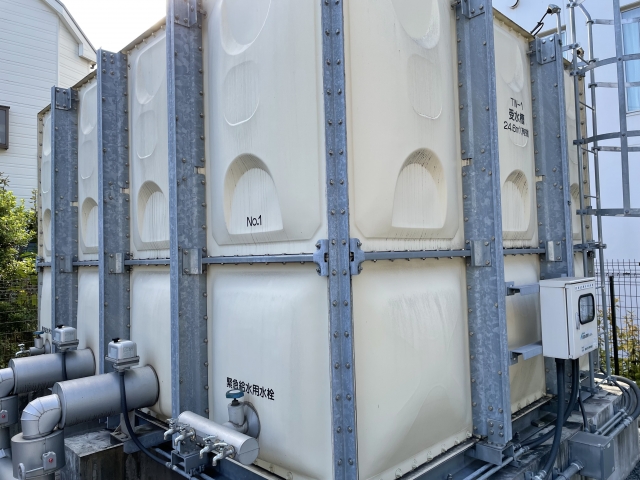
There are three types of water storage tanks, as shown below.
| Type | Characteristics |
| Receiving tank |
This tank temporarily stores water supplied by the waterworks bureau and supplies it to the water taps on each floor as needed. This has the advantage that water pressure does not drop even when a large volume of water is used at one time. It is mainly installed on the ground outside a building or underground. |
| Elevated water tank (overhead tank) |
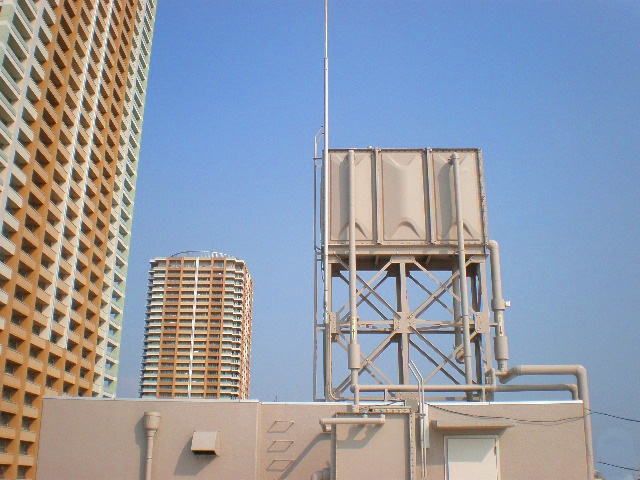
An elevated water tank is a tank installed at a high location, such as on the roof of a building. In some cases, water is pumped up from a receiving tank and stored in an elevated water tank (receiving-tank/elevated-tank system). In other cases, water from a water supply pipe or water supplied by the waterworks bureau is sent directly by pump to an elevated water tank (direct booster elevated-tank system). After that, water is supplied to each floor using gravity. Its main characteristic is that it can supply water at stable pressure. |
| Hot water storage tank | This tank stores water heated by a boiler, heat pump, or similar equipment and supplies it to various locations as needed. |
Why Is Water Storage Tank Cleaning Necessary?
Supplying safe and reliable drinking water
Regular cleaning is necessary to supply hygienic, safe, and reliable drinking water to building users and residents.
Metal parts such as bolts are used inside water storage tanks. When they are exposed to chlorinated tap water for a long time, rust can form on the metal parts. As corrosion progresses from there, dirt may accumulate inside the tank, and bacteria or foreign matter may enter. If cleaning is neglected, unhygienic drinking water could be supplied.
Regular cleaning at least once a year is mandatory under Japan’s Waterworks Law
Under Japan’s Waterworks Law, water storage tanks with an effective capacity of more than 10 m3 are required to undergo regular cleaning at least once a year.
Under Japanese law, violations may be subject to a fine of up to 1 million yen, so sufficient caution is required.
Small-scale water storage tanks of 10 m3 or less may also be required to undergo regular cleaning under local government ordinances in Japan, so they must be managed in accordance with the ordinances of the location.
Differences in cleaning obligations according to water storage tank size
Depending on the size of the water storage tank, cleaning obligations differ as follows.
| Type of water storage tank | Description | Cleaning obligation |
| Private-use water supply system | A water storage tank with an effective capacity of more than 10 m3 used to supply drinking water to a building | Under Japan’s Waterworks Law, regular cleaning and water quality testing at least once a year are mandatory. In addition, under local government ordinances in Japan, it may also be necessary to promptly report self-inspection results to the public health center. |
| Small-scale water storage tank water supply system | A water storage tank with an effective capacity of 10 m3 or less | Local government ordinances in Japan define a duty to make efforts to manage these facilities in the same manner as private-use water supply systems. |
Water storage tank cleaning must be performed by qualified personnel with specialized knowledge and skills. Check whether the company has qualified personnel such as a Water Storage Tank Cleaning Work Supervisor on staff and whether it is registered in Japan as a Building Drinking Water Storage Tank Cleaning Business.
Under Japan’s Waterworks Law, private-use water supply systems (water storage tanks with an effective capacity of more than 10 m3) are required to undergo a periodic inspection once a year. The inspection covers the inside and outside of the water storage tank, insect screens on vent pipes, confirmation that manholes are sealed, residual chlorine, and other items.
Details of Water Storage Tank Cleaning Work
The details of water storage tank cleaning are explained below. Receive a cleaning report from the cleaning company and carefully check which areas were cleaned.
Cleaning inside the water storage tank
Workers enter the water storage tank and carry out the cleaning. Dirt, scale, and other buildup inside the tank are thoroughly washed away.
Disinfecting inside the water storage tank
After cleaning the inside of the water storage tank, disinfection is performed to keep it clean.
A sodium hypochlorite solution is applied inside the tank, left for 30 minutes, and then rinsed with water. This is repeated at least twice to disinfect the tank.
Water quality testing
After the water storage tank has been cleaned and disinfected, the tank is filled with water and water samples are collected for water quality testing. Residual chlorine is measured, and the water is checked for abnormalities in color, odor, taste, and other characteristics.
Equipment maintenance
Equipment such as water supply pumps, lift pumps, and alarm panels is inspected. The equipment is carefully checked to confirm that it operates properly.
Exterior cleaning
The exterior walls of the water storage tank are cleaned, and deterioration and damage are checked. Some companies do not clean the exterior of the water storage tank, so confirm this at the time of contract.
At AMCON, not only interior cleaning but also exterior cleaning is included in the work cost!
Water Storage Tank Cleaning Process
1. Inquiry and estimate
When requesting water storage tank cleaning, first contact a specialized cleaning company. The first point to confirm at this stage is whether the company is registered as a “Building Drinking Water Storage Tank Cleaning Business” in Japan.
Some companies may provide an estimate without conducting an on-site survey. However, in the case of a single-unit, single-chamber water storage tank, water service will be interrupted during cleaning, so an on-site check is performed. (A single-unit, two-chamber water storage tank can be cleaned without interrupting the water supply.)
2. Adjusting the cleaning schedule
Once you are satisfied with the estimate, the schedule for the actual cleaning work is arranged.
3. Notification to residents / building users
The date and time of cleaning and water service interruption are announced to building users.
4. Performing the cleaning work
The cleaning details introduced above are carried out.
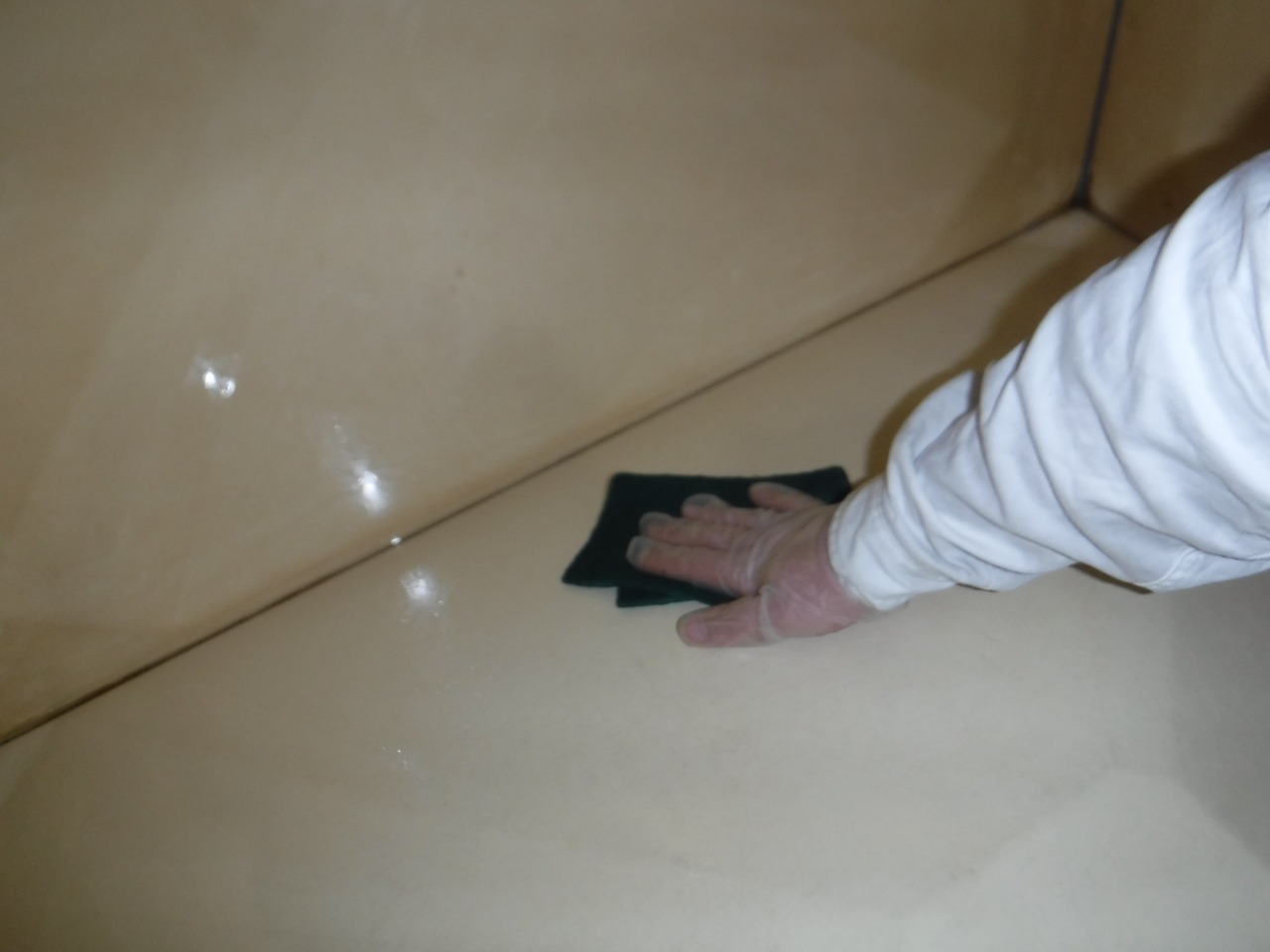
Workers enter the water storage tank and clean it. Photos are also taken before, during, and after cleaning. Dirt, scale, and impurities inside the tank are removed. The walls are thoroughly cleaned using a high-pressure washer and scrubbed with brushes as needed. After washing, the wastewater is completely drained and wiped away. Next, chlorine disinfection is performed. A sodium hypochlorite solution is applied inside the tank, left for 30 minutes, and then rinsed with water. This is repeated at least twice to disinfect the tank.
5. Work completion and reporting
When the cleaning work is complete, a detailed work report is submitted to the client. Because AMCON can also perform water quality testing in-house, if you request it at the same time, we will also submit a water quality test report.
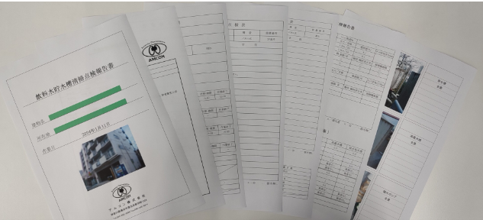
The report includes the cleaning details, work photos, the type of disinfectant used, the names of the workers, and advice on future maintenance.
Market Rate for Water Storage Tank Cleaning Costs
Water storage tank cleaning costs vary depending on the scale of the cleaning, the type of water storage tank, and the location.
Main factors affecting costs
Size of the water storage tank: The larger the water storage tank, the more time and labor are required for cleaning, so the cost becomes higher.
What Happens if Water Storage Tank Cleaning Is Not Performed?
If water storage tank cleaning is neglected, various problems may occur, leading to deterioration in water quality and increased health risks. Water storage tank cleaning is an obligation that building managers must observe under Japanese law and applicable local requirements, and failure to perform cleaning may result in a fine of up to 1 million yen, so caution is required.
Summary
This article provided a detailed explanation of water storage tank cleaning.
Cleaning water storage tanks is extremely important from the standpoint of water quality maintenance and hygiene management. By performing regular cleaning, a hygienic environment can be maintained and safe water can be secured.
In addition, cleaning is legally required under Japanese law, and maintenance at an appropriate frequency is required. Cleaning work must follow specialized procedures, so it is recommended to request service from a specialized company that can perform not only cleaning but also water quality testing and pump inspections. Please consider consulting AMCON about water storage tank cleaning with reference to this article.
