
Column Plumbing System Inspection
- TOP
- Useful Information
- Plumbing System Inspection
- About Building Water Tank System Inspection
2024.12.25
About Building Water Tank System Inspection
Contents
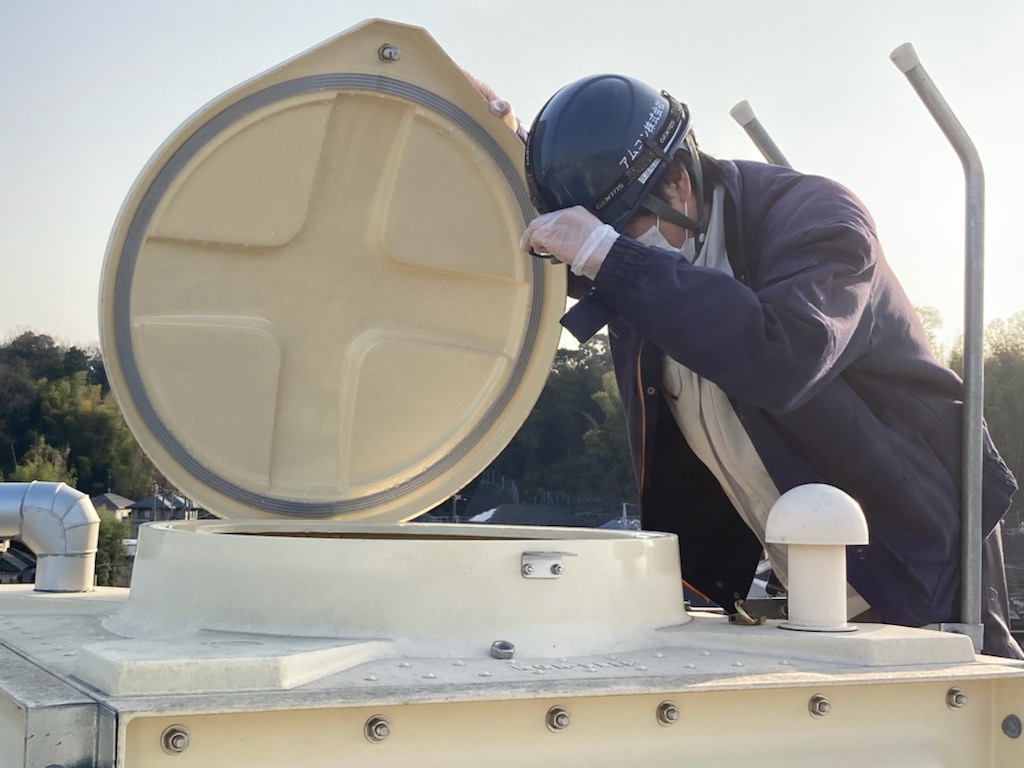
Building Water Tank System Inspection is an essential inspection for ensuring the safety of drinking water. This article explains what Building Water Tank System Inspection involves, how often it should be conducted, and other key points. It also introduces frequently asked questions about Building Water Tank System Inspection at the end.
What Is Building Water Tank System Inspection?
A Building Water Tank System refers to a facility that first stores water supplied by a water supplier in a receiving water tank and then supplies that water to a building, where the effective capacity of the receiving water tank exceeds 10 cubic meters. The installer of a Building Water Tank System is required to properly manage the facility in order to use safe and hygienic water and to supply such water to users.
Building Water Tank System Inspection is conducted by a registered testing institution and is carried out in accordance with standards based on applicable laws and regulations in Japan.
Scope of Building Water Tank System Inspection
Receiving water tanks at the following types of facilities, and elevated water tanks installed on building rooftops, are considered Building Water Tank Systems when their effective capacity exceeds 10 cubic meters.
- Apartment buildings and other multi-unit residential buildings
- Commercial facilities and office buildings
- Public facilities such as schools and hospitals
- Factories and industrial facilities (not applicable if the water is not used as drinking water)
Required Sanitary Management
To properly conduct Building Water Tank System Inspection, sanitary management based on Japanese laws and regulations is essential.
This section explains in detail the inspection by a registered testing institution and sanitary management based on Article 55 of the Regulation for Enforcement of Japan’s Water Supply Act.
Inspection by a Registered Testing Institution (Statutory Inspection)
To maintain the sanitary condition of the water supply system, periodic inspection by a registered testing institution is required (at least once every year).
The testing institution professionally evaluates the water quality and the condition of the equipment, and confirms whether the water supply system is being operated in compliance with Japanese laws and regulations. Based on the inspection results, the owner or manager is required to take any necessary corrective measures, ensuring thorough sanitary management.
Main Inspection Details
1. Inspection of the Exterior and Interior of the Receiving Water Tank, etc.
The inspection covers the exterior and interior of the receiving water tank, insect screens on vent pipes, confirmation that manholes are tightly sealed, and the management conditions in the surrounding area.
2. Water Quality Testing
At the water tap, the inspection checks the odor, taste, color, chromaticity, turbidity, and residual chlorine of the water.
3. Document Inspection
The inspection reviews drawings related to the water supply equipment, reports on water storage tank cleaning, and other records such as daily inspection logs.
Reporting to the Public Health Center
After Building Water Tank System Inspection is conducted, reporting to the public health center is required. Proper reporting helps ensure compliance with Japanese laws and regulations and allows the dedicated water supply system to be used with confidence.
Because failure to conduct the inspection may result in legal penalties, it is important to make sure that periodic inspection is carried out at least once every year.
Sanitary Management (Article 55 of the Regulation for Enforcement of Japan’s Water Supply Act)
Article 55 of the Regulation for Enforcement of Japan’s Water Supply Act sets forth specific standards for the sanitary management of dedicated water supply systems. The main management items are introduced below.
Cleaning of Water Storage Tanks
Water storage tanks must be cleaned periodically. The frequency and method of cleaning are extremely important because they are directly linked to maintaining water quality. Specifically, under Japan’s Water Supply Act, receiving water tanks with an effective capacity exceeding 10 m³, for which Building Water Tank System Inspection is mandatory, are defined as Building Water Tank Systems, and cleaning at least once every year and water quality testing by a registered testing institution are required. In addition, installers of small-scale receiving water tank systems with an effective capacity exceeding 8 cubic meters, as well as all underground receiving water tanks, are also required to undergo inspection of management conditions at least once every year. For tanks with an effective capacity of 8 cubic meters or less, cleaning, inspection, and other checks equivalent to those for small-scale receiving water tank systems are considered recommended duties.
After these receiving water tanks are cleaned, water quality testing is conducted to confirm that the water quality satisfies the required standards.
Because AMCON can conduct water quality testing in-house, you can also consult us about water quality testing after water storage tank cleaning.
Inspection of Other Facilities
Inspection of the entire water supply facility is also essential. Periodic inspection makes it possible to detect water leaks and deterioration of equipment at an early stage and to carry out repairs promptly.
Inspection items include checking the condition of piping and receiving water tanks, confirming the operation of constant water level valves, and checking the appearance and operation of pumps.
Click here for details on water supply equipment inspection services.
Conducting Water Quality Testing
Maintaining and managing water quality is essential for protecting the health and safety of users.
It is advisable to check the following items for water quality testing.
- Check the water condition every day
- Measure residual chlorine once a week
- Conduct water quality testing based on the water quality standards under Japan’s Water Supply Act
Checking the Water Condition
Use a transparent glass and draw tap water from the faucet.
Visually check the color and turbidity of the water. Also check the odor and taste.
Measuring Residual Chlorine
Measure residual chlorine using a measuring instrument. If no residual chlorine is detected, or if the measured value has dropped significantly compared with the previous measurement, there is a problem with the water quality.
Water Quality Testing
Water quality testing should be conducted once a year. The water quality testing items are as follows.
- General bacteria
- Escherichia coli
- pH value
Nonconformities
A nonconformity in Building Water Tank System Inspection refers to a condition that does not conform to laws, regulations, or standards. If a nonconformity is detected, appropriate measures must be taken.
Main Nonconformities
The following are specific examples of nonconformities often found during Building Water Tank System Inspection.
| Nonconformity | Description |
| Violation of water quality standards | A concentration of hazardous substances exceeding the standard values specified under Japan’s Water Supply Act is detected. |
| Contamination of the water storage tank | Dirt inside the water storage tank or the growth of algae is confirmed. |
| Aging equipment | Water leakage or supply failure has occurred due to aging equipment. |
| Inadequate sanitary management | Periodic cleaning or disinfection has not been conducted. |
| Deficiencies in reports | Required reports or records have not been properly stored or submitted. |
Frequently Asked Questions
Frequently asked questions about Building Water Tank System Inspection are summarized below.
Q: We already conduct water quality testing. Do we still need to undergo inspection by a registered testing institution?
A: Yes, it is necessary. Even if you manage water quality testing independently, Japanese laws and regulations require inspection by a testing institution registered with the Minister of Health, Labour and Welfare of Japan. This ensures the impartiality and reliability of the inspection results and guarantees the supply of safe water to users.
Q: Will there be any water outage during the inspection?
A: Building Water Tank System Inspection does not involve a water outage.
Q: Are there any penalties if the inspection is neglected?
A: If the inspection is neglected, a fine of up to 1 million yen may apply. (Article 54, Item 8 of Japan’s Water Supply Act)
Summary
This article introduced Building Water Tank System Inspection.
Building Water Tank System Inspection is indispensable for maintaining sanitary management at facilities and ensuring a safe water supply.
By properly performing required items such as periodic inspection by a registered testing institution, cleaning of water storage tanks, and equipment inspection, you can avoid penalties for violations of laws and regulations and supply safe and reliable water to users. Appropriate management also helps maintain water quality and extend the service life of facilities. Please use this article as a reference when considering AMCON’s Building Water Tank System Inspection.
