
Case Facility Renovation Work
- TOP
- Case Studies
- No More Water Supply Pump Unit Replacement or Receiving Water Tank Maintenance! Switching to a Direct Pressure Water Supply System for Reliability and Cost Savings
No More Water Supply Pump Unit Replacement or Receiving Water Tank Maintenance! Switching to a Direct Pressure Water Supply System for Reliability and Cost Savings
Apartment Building, Tokyo
- #Buildings
- #Apartments
- #Water Supply System Conversion Work
- #Facility Renovation Work
Contents
Background of the Request
We received a request through a property management company from the owner of a three-story apartment building in Tokyo, asking us to repair deteriorated piping around the water supply pump unit. As a result of the on-site preview, we confirmed a “cross-connection” in which the pipe before the receiving water tank and the piping after the receiving water tank were directly connected. A cross-connection may cause water quality contamination through backflow and is a connection method prohibited under Japan’s Waterworks Law.
The owner thought, “Even if the pump fails, it is convenient because opening the red valve before the receiving water tank prevents a water outage.” However, based on materials from the Tokyo Waterworks Bureau, we explained the illegality and danger of the connection and proposed switching to a direct pressure water supply system.
Problems with Cross-Connections
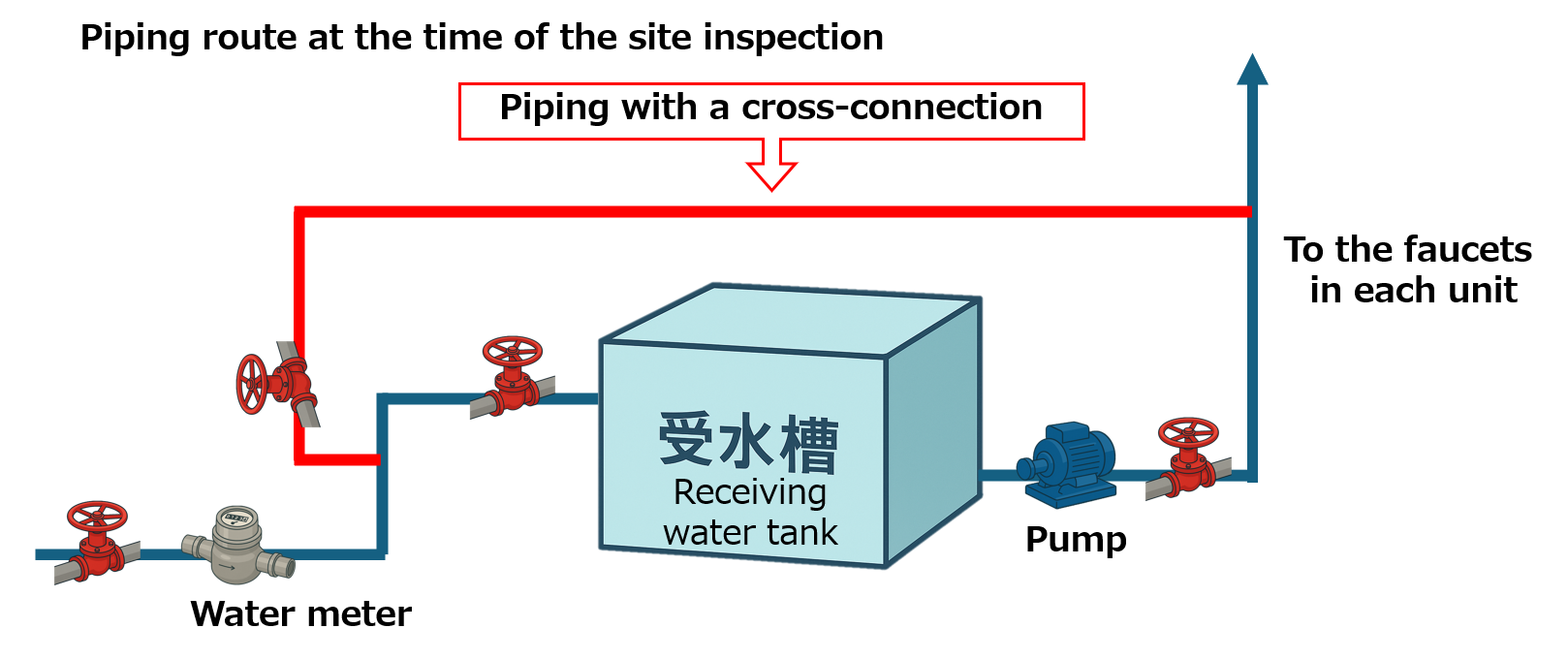
A cross-connection refers to a condition in which a water pipe and another piping system are mistakenly connected directly.
- If there is no backflow prevention device during a water outage or similar event, contaminated water may flow back into the water pipes
- As a result, contaminated water may flow into surrounding homes
- Actual cases have been reported in which pesticides or well water flowed back and caused accidents
To protect safe water, Tokyo also conducts ongoing investigations and corrective actions.
What Is Direct Pressure Water Supply System Conversion Work?
This is a method of delivering water directly from the water mains to each unit without using a receiving water tank or pump.
With a receiving water tank system, maintenance and management costs are required to respond to failures and deterioration, such as water supply pump unit replacement (approximately JPY 1.5-2.0 million every 10-15 years) and receiving water tank replacement (approximately JPY 3.0-4.0 million). With a direct pressure water supply system, however, neither the water supply pump unit nor the receiving water tank itself is required.
[Advantages]
- Major cost reductions because water supply pump and receiving water tank renewal costs are no longer required
- Electricity costs previously required to operate the water supply pump are reduced by using pressure from the water mains
- The risk of water outages due to water supply pump failure is eliminated
- Periodic maintenance and management, such as receiving water tank inspection, cleaning, and painting, are also no longer required
- Because water does not pass through a receiving water tank, fresh, safe water can always be supplied from the water mains to each unit
- The site can be used more effectively because space for the receiving water tank is no longer required
Note: As a consideration, water outages may occur during accidents or disasters because there is no storage function.
Work Highlights
This work was carried out over approximately two weeks (1/23-2/4).
- Prior confirmation with the waterworks bureau and diameter enlargement work
- Asphalt excavation -> piping renewal and diameter enlargement
- Installation of new valves, check valves, and bypass unit
- Installation of air intake/exhaust valves in each unit (three-story building)
- Removal of the existing receiving water tank and pump unit -> asphalt restoration
- Application to the waterworks bureau
The water outage lasted only one day (9:00-17:00). The impact on residents was kept to a minimum.
Results After Completion
- The equipment became simpler, significantly reducing future renewal, maintenance, and management costs
- The safe direct water supply method helped avoid the risk of water quality accidents
- An environment was created in which residents can use the water supply with peace of mind
Summary
Although a cross-connection may appear convenient, it is illegal and carries the risk of causing serious water quality accidents. We provide one-stop support, from on-site investigations to optimal proposals based on applicable laws and regulations in Japan. Please feel free to contact us if you are concerned about maintenance and management costs for a receiving water tank or water supply pump, or if you want to improve water quality safety.
