
Column Plumbing System Cleaning Service
- TOP
- Useful Information
- Plumbing System Cleaning Service
- Grease Trap (Grease Interceptor): Mechanism and Cleaning Frequency Explained
2025.07.11
Grease Trap (Grease Interceptor): Mechanism and Cleaning Frequency Explained
Contents
For anyone who wants to understand what a grease trap is, how it works, and how to clean it, this article is essential reading. It explains the proper cleaning frequency for grease traps, which are indispensable in restaurants, as well as the risks of neglecting cleaning. In fact, proper cleaning helps prevent foul odors and pests. After reading this article, you will understand how to manage grease traps properly.
Many people may feel that they would rather avoid cleaning a grease trap if possible. Grease traps are indispensable in restaurant kitchens, yet many operators have questions about their role and proper management.
If odors start coming from a grease trap, restaurant sales may be affected. If it is left uncleaned, problems such as clogged drainage pipes and backflow may occur.
This article explains how grease traps work, proper cleaning methods, and three problems that can occur when cleaning is neglected.
Please read to the end to help prevent grease trap problems.
A Grease Trap Is an Oil and Grease Separator/Interceptor
A grease trap is a device that temporarily intercepts unwanted substances, such as fats, oils, grease, and food scraps contained in wastewater from restaurant kitchens, so that they do not flow directly into the sewer. Its formal name is an oil and grease separator/interceptor. It is mainly installed to prevent wastewater from contaminating the sewer system or causing blockages.
A grease trap is characterized by its function of “trapping” grease. This device helps maintain wastewater quality at a level that can be discharged into the sewer system and reduces the burden on the natural environment.
In commercial kitchens, grease traps are indispensable for restaurants, where far more grease and food waste are generated than in ordinary household wastewater. As explained later, some local governments in Japan require installation in order to reduce the impact on sewers. Grease traps separate and temporarily store food waste and grease.
Although this is a useful device, regular cleaning is important because improper management can cause foul odors and pest problems.
Grease Trap Installation Requirements for Restaurants Differ Depending on Laws, Regulations, and Local Governments in Japan
Grease trap installation is not mandated by a single nationwide law in Japan. However, wastewater discharge standards are established under Japanese laws such as Japan’s Building Standard Law, Japan’s Sewerage Law, and Japan’s Water Pollution Prevention Act. In most cases, a grease trap is ultimately necessary in order to meet the discharge standards set by these laws and regulations.
Under Japan’s Building Standard Law, building equipment must use structural methods specified by the Minister of Land, Infrastructure, Transport and Tourism. If oils, grease, or food waste may damage drainage facilities, an interceptor must be installed. Even though this provision does not explicitly use the term “restaurant,” commercial kitchens fall within the relevant conditions, so grease trap installation is effectively required.
Facilities such as restaurants with a floor area of 420 m2 or more that fall under the category of specified facilities are subject to Japan’s Sewerage Law and Japan’s Water Pollution Prevention Act. Some local governments in Japan, such as Tokyo, require all restaurants to install grease traps by ordinance. Therefore, restaurants must check the ordinances of the municipality where they are located.
Reference::Tokyo Metropolitan Bureau of Sewerage, “Request to Restaurant Operators”
Furthermore, under Japan’s Building Sanitation Law (the Act on Maintenance of Sanitation in Buildings), facilities of a scale that qualify as “specified buildings” are required to conduct regular inspections and cleaning of drainage facilities, including grease traps. This Japanese law requires cleaning at least once every six months. Some local governments in Japan require cleaning at least three times a year, or once every four months, so it is advisable to confirm the requirements in advance.
How Grease Traps Work
A grease trap is divided into three chambers, each with a different role.
- The first chamber removes larger waste.
- The second chamber separates water from fats, oils, and grease.
- The third chamber further separates the wastewater before discharging it to the sewer.
Let’s look at the role of each chamber in order.
The First Chamber Removes Larger Waste
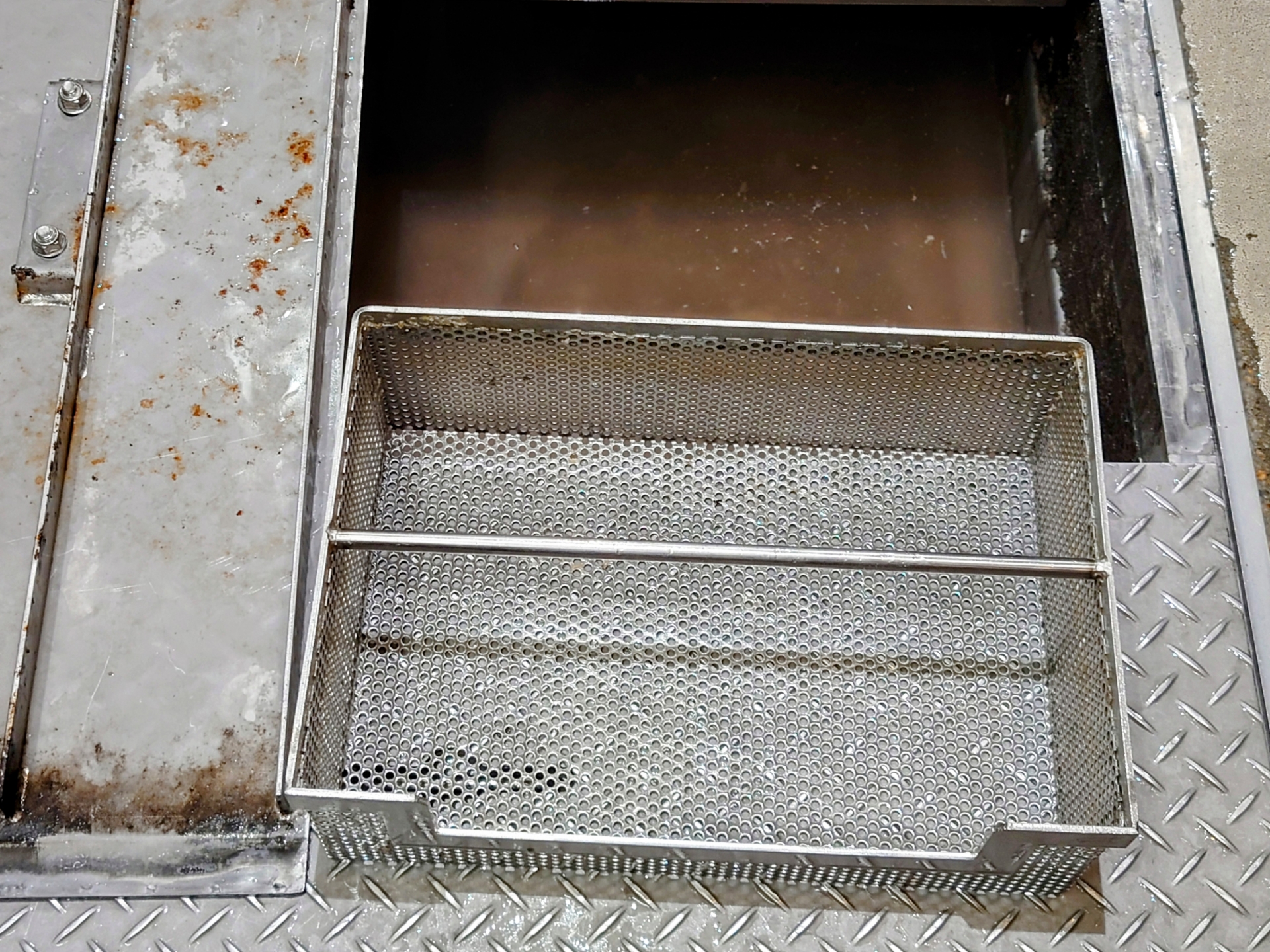
The first chamber of a grease trap is where wastewater from the kitchen first flows in. It mainly removes larger waste, food scraps, vegetable scraps, and similar solids. A basket-shaped “waste basket” is installed in the first chamber to collect solids that flow in with the wastewater.
Because larger solids such as leftover food are caught in the waste basket, they can be prevented from flowing into subsequent chambers or drainage pipes. Removing solids at this stage improves grease separation efficiency and helps maintain the overall function of the grease trap.
The Second Chamber Separates Water from Fats, Oils, and Grease
The second chamber receives wastewater after large solids have been removed in the first chamber, and it separates water from fats, oils, and grease. This separation is possible because water and oil have different specific gravities. Oil is lighter than water, so it rises to the surface and accumulates as scum, or an oil layer.
Oil used for frying and fats from meat and fish rise to the water surface and are separated from the relatively clean water in the lower layer. The second chamber often has baffle plates that promote the separation of water and oil, and their role is to prevent the floating grease from flowing into the next chamber.
The Third Chamber Further Separates Wastewater Before Discharging It to the Sewer
The third chamber of a grease trap is the final stage, into which wastewater flows after grease has been separated in the second chamber. It further separates fine floating matter and sediment, and ultimately discharges the cleaned water into the sewer. In the third chamber, any remaining fine grease still rises to the water surface, while the remaining sediment settles at the bottom of the chamber.
In other words, the small amount of grease that could not be removed in the second chamber is completely separated in this final chamber, and wastewater without oil is discharged into the sewer system. The third chamber is connected to a drainage pipe, through which wastewater is sent to the public sewer system.
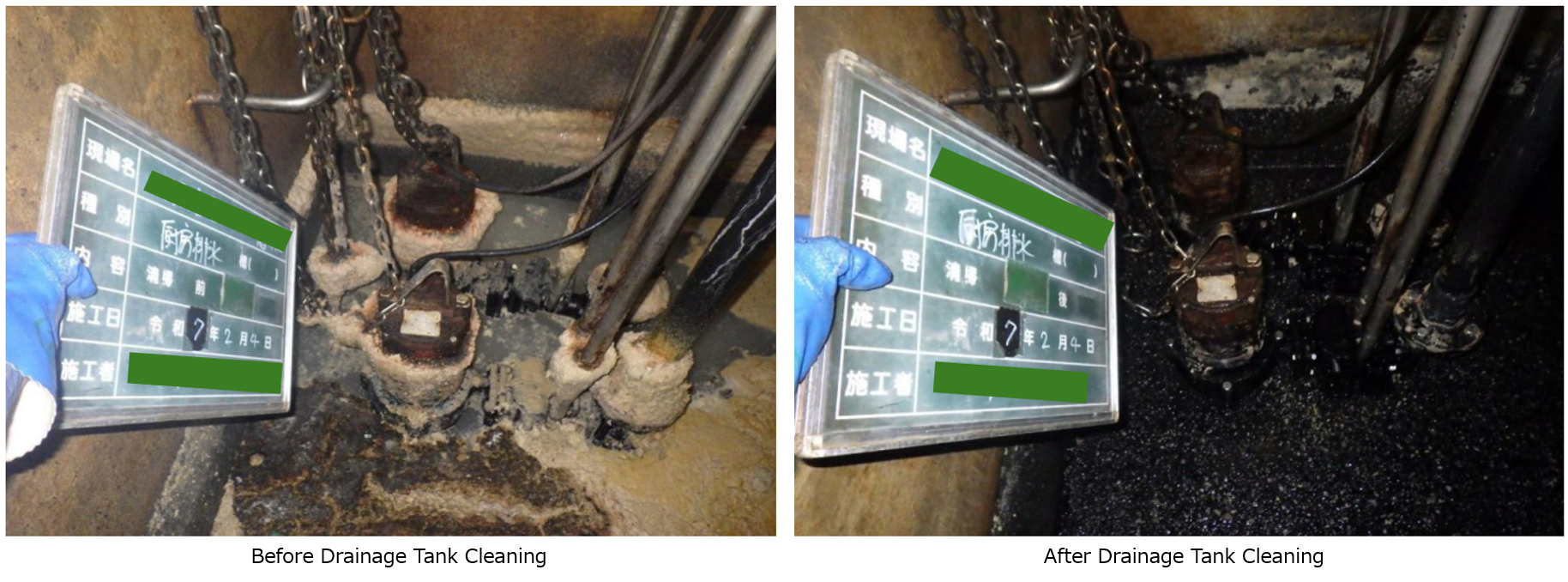
In kitchens located in the basements of buildings or commercial facilities, wastewater cannot flow directly to the public sewer because the kitchen is located below the level of the public sewer. Therefore, a “drainage tank (building pit)” is installed to temporarily store wastewater discharged from the grease trap. The water accumulated in the drainage tank is pumped up to the public sewer system at ground level.
As mentioned above, if this drainage tank is in a facility that qualifies as a “specified building” under Japan’s Building Sanitation Law, Japanese law requires cleaning at least once every six months. In addition, some local governments in Japan require cleaning at least three times a year, so it is important to confirm the local rules for the facility’s location.
Proper Cleaning Frequency and Cleaning Methods for Grease Traps
By combining daily cleaning by store staff with regular vacuum cleaning by a specialist contractor, the risk of foul odors and drainage problems can be minimized.
When a grease trap is cleaned by a specialist contractor, the visual difference can be as dramatic as shown here.
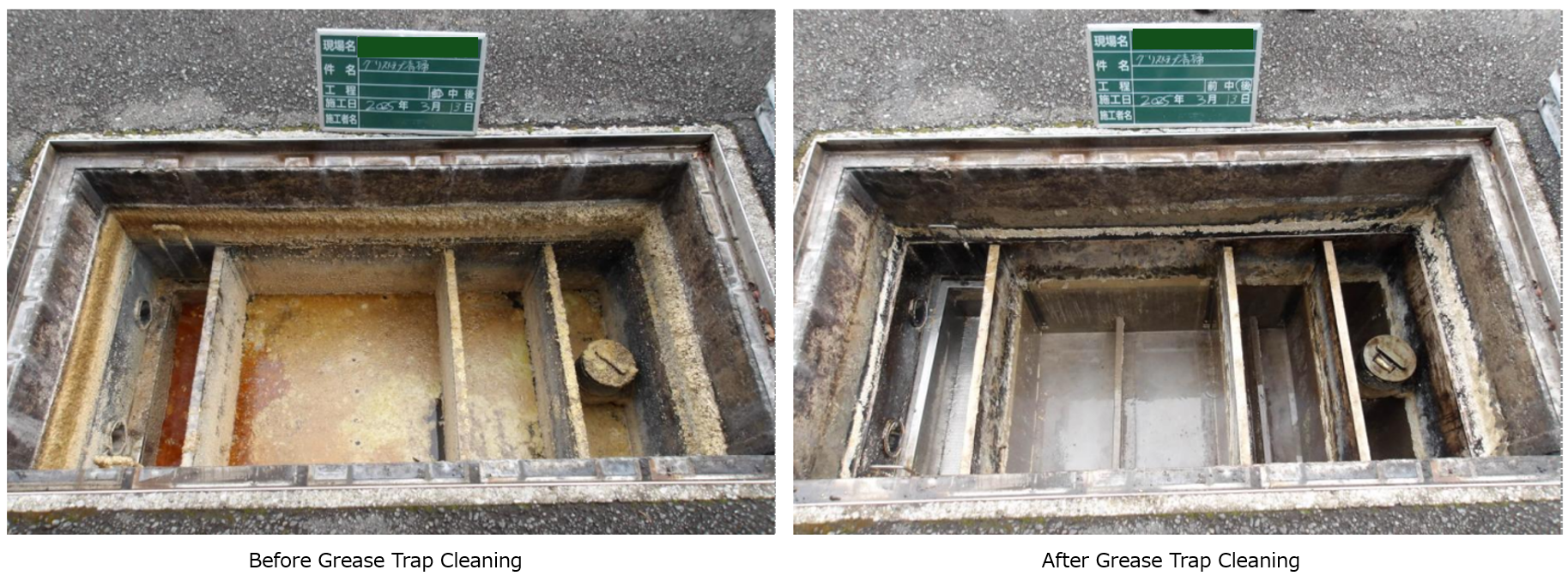
As shown, fats, oils, grease, and sludge accumulate in the trap, making the importance of regular cleaning obvious at a glance. The following sections explain the cleaning frequency and methods for each chamber in detail.
Cleaning Frequency and Cleaning Method for the First Chamber
The first chamber of a grease trap should be cleaned every day. This is because food scraps, vegetable scraps, and other large solids discharged from the kitchen flow directly into the first chamber, making it an area where dirt accumulates easily. If cleaning is neglected, these solids may decompose, causing foul odors and reducing the function of subsequent chambers.
To clean it, first remove the waste basket and take out all accumulated waste. Drain the removed waste thoroughly, and dispose of it properly as general waste. Next, wash the waste basket and the inside of the chamber with a brush to remove adhered dirt. Using detergent at this stage is even more effective.
Be sure to remove the basket and thoroughly clean any fine waste that has settled beneath it. If cleaning is neglected, grease will have difficulty passing through the wire mesh, which can cause clogging. Cleaning every day helps prevent problems before they occur.
Waste inside the basket-shaped waste collector is treated as general waste. However, sedimented waste inside the grease trap is generally classified as industrial waste under Japan’s waste-disposal framework, so it should be handled by a specialist company.
Cleaning Frequency and Cleaning Method for the Second Chamber
In the second chamber of a grease trap, fats, oils, and grease that have risen to the water surface, known as scum, should be removed about two to three times a week. If cleaning of the second chamber is neglected, oil can accumulate and may cause foul odors, drainage backflow, and even sewer pipe blockages. In stores that use large amounts of oil, it is preferable to do this every day if possible.
To clean it, first use a mesh skimmer or ladle to carefully scoop off the scum floating on the water surface. It is important never to pour the removed grease into the sewer.
The “sludge such as grease” in the second chamber is generally classified as industrial waste in Japan. It is difficult for business operators to treat this waste themselves, so it must be handled properly by a licensed industrial waste disposal contractor.
Cleaning Frequency and Cleaning Method for the Third Chamber
The third chamber of a grease trap must be cleaned about once a month to remove sludge-like sediment that accumulates at the bottom of the chamber and any remaining floating grease. This is because fine solids and grease settle or float in this chamber. The third chamber plays the role of discharging wastewater from which grease has ultimately been removed into the sewer. If cleaning is neglected, sediment will build up, reducing drainage capacity and causing foul odors.
To clean it, first remove any remaining floating grease with a mesh skimmer, as with the second chamber. Next, remove the sludge-like sediment at the bottom of the chamber with a vacuum pump or ladle. At this time, check the grease adhering to the drain trap at least once a month and clean it thoroughly. Sludge such as grease must be handled by an industrial waste disposal contractor in Japan.
For all chambers, odors coming from the grease trap serve as an indicator for cleaning. It is important to clean the trap before odors become strong, so that foul odors and dirt accumulation do not worsen.
Three Problems Caused by Neglecting Grease Trap Cleaning
This section introduces three problems that can occur when grease trap cleaning is neglected.
- Foul odors
- Pests
- Clogged drainage pipes
Let’s look at each in detail.
Foul Odors
If grease trap cleaning is neglected, unpleasant odors will first occur in the kitchen and inside the restaurant. This is because accumulated grease, food scraps, sludge, and other dirt inside the grease trap decompose and generate gases such as hydrogen sulfide.
An uncleaned grease trap may emit a strong odor similar to a ditch or rotting food waste. Foul odors can make customers uncomfortable and reduce employee motivation. They may also damage the store’s image and lead to a decline in customer traffic.
To prevent foul odors, it is important to clean out sediment regularly and remove waste and sludge frequently.
Pests
If grease trap cleaning is neglected, foul odors may also lead to the mass occurrence of pests such as cockroaches and flies. Grease and food scraps accumulated inside the grease trap provide an ideal feeding area for pests and create an environment suitable for breeding.
Around grease traps that have not been cleaned for a long time, cockroach nymphs and adults may gather, and flies may be seen flying around. Pests can enter not only the kitchen but also the dining area, increasing the risk of food poisoning and giving customers the impression that the restaurant is unsanitary.
From the perspective of preventing pests, store hygiene management is extremely important.
Clogged Drainage Pipes
If grease trap cleaning is neglected, the risk of clogged drainage pipes eventually increases. Grease and solids that are not separated by the grease trap flow into sewer pipes with the wastewater and adhere to and solidify on the inner walls of the pipes.
As cooled grease solidifies inside the pipes and gradually accumulates, drainage flow worsens. Wastewater from the kitchen sink may flow back, and in the worst case, the drainage pipe may become completely blocked. If wastewater backflows, foul odors may occur and water may overflow into the kitchen, disrupting store operations.
For these reasons, regular grease trap cleaning is necessary to prevent clogged drainage pipes. If a situation occurs in which drainage pipes become clogged, leave grease trap cleaning, including the drainage tank, to a specialist contractor.
Summary | Understand How Grease Traps Work and Clean Them Properly
A grease trap is an “oil and grease separator/interceptor,” a device that prevents grease and food scraps in restaurant kitchen wastewater from flowing into the sewer. It prevents sewer contamination and blockages, and installation is effectively required for many restaurants in Japan. If not properly managed, it can cause foul odors and pest problems, so regular cleaning is important.
A grease trap is divided into three chambers, each with a different role.
- First chamber: removes larger waste (daily cleaning is recommended)
- Second chamber: separates water from fats, oils, and grease (cleaning two to three times a week is recommended)
- Third chamber: further separates wastewater and discharges purified water into the sewer (monthly cleaning is recommended)
If cleaning is neglected, the following three problems occur.
- Foul odors
- Pests
- Clogged drainage pipes
Regular cleaning before odors become strong is especially essential. Sedimented waste in the first chamber and sludge such as grease in the second chamber are classified as industrial waste in Japan, so they must be handled by an industrial waste disposal contractor.
Please Feel Free to Contact Us for Grease Trap and Drainage Tank Cleaning
To prevent problems such as strong foul odors from grease traps or wastewater from drainage tanks flowing into your store, please feel free to contact AMCON Inc., a company with extensive experience and reliable technical capabilities. We carefully clean drainage tanks, grease traps, and related equipment to resolve customer concerns.
Please also leave total support to us, from cleaning to inspection and construction work related to plumbing systems, as well as pest control.
